
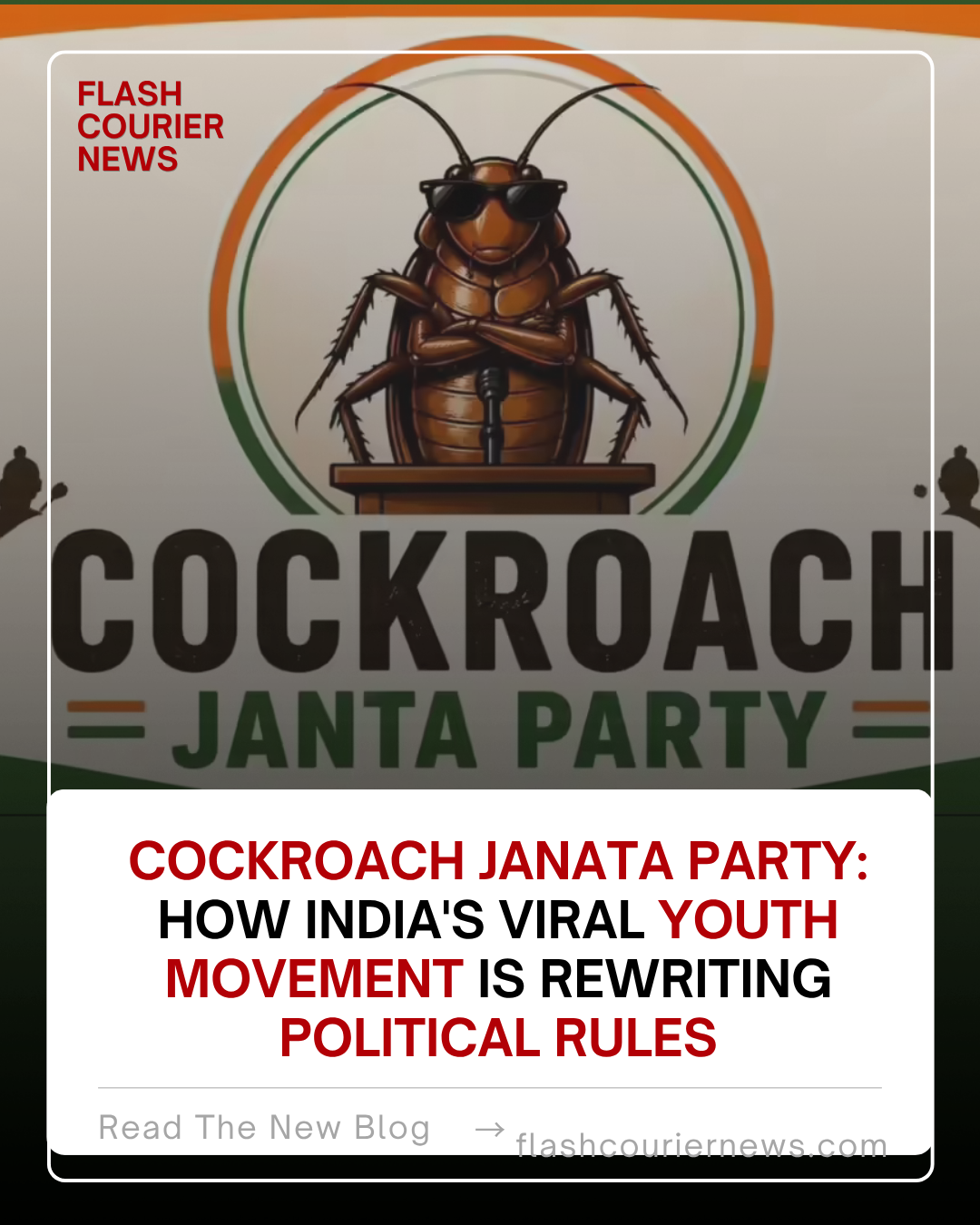
How India’s Viral Youth Movement Is Rewriting Political Rules
There was no campaign office where the Cockroach Janata Party began. An insult was the first thing that happened. Chief Justice Surya Kant of India referred to young people without jobs as “cockroaches” and “parasites of society” in public on May 15, 2026. Gen Z had transformed that insult into a movement by the following morning. In a matter of days, the Cockroach Janata Party transcended national boundaries, ignited imitation movements in Pakistan, and fundamentally altered our understanding of political protest in the digital age.
This is not just a meme. This is a signal.
How One Supreme Court Remark Ignited a Nation
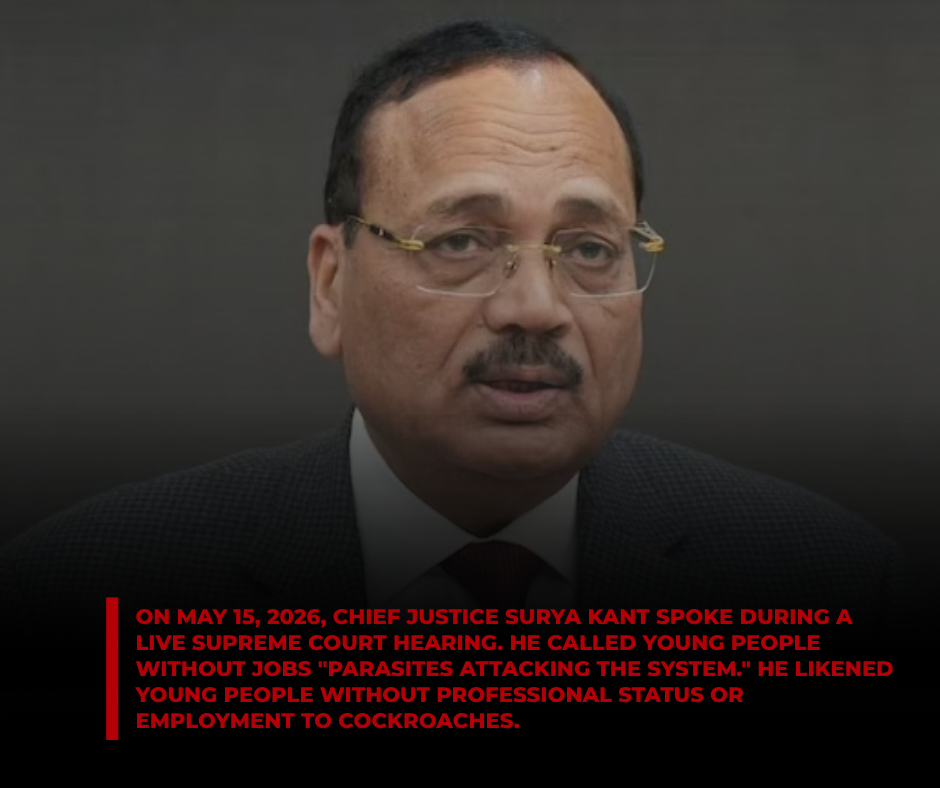
On May 15, 2026, Chief Justice Surya Kant spoke during a live Supreme Court hearing. He called young people without jobs “parasites attacking the system.” He likened young people without professional status or employment to cockroaches. Later, the CJI clarified that he was referring to those who use phoney degree certificates. However, the harm had already been done. The cut was already quite deep.
India’s youth unemployment rate is at historically high levels. Millions of young Indians are vying for fewer and fewer jobs. The public’s trust in fair hiring has been shaken by examination controversies. When the country’s highest judge used terms like “cockroach,” young people heard something different. They heard disdain. Overnight, social media exploded.
The comment went viral on WhatsApp, Instagram, and X. Politicians from the opposition took advantage of the situation to harass the ruling class. But something more significant was subtly emerging.
Who Is Abhijeet Dipke? The Man Behind the Movement
One man reacted to the insult in a different way. Abhijeet Dipke is a political communication strategist with expertise in digital media influence, narrative construction, and public messaging. In Pune, he completed his undergraduate studies in journalism. After that, he moved to the US to continue his education.
At Boston University, he is presently pursuing a master’s degree in public relations. From 2020 to 2023, he volunteered for the Aam Aadmi Party’s social media team. He led AAP’s meme-driven online campaigns during the 2020 Delhi elections.
Dipke announced the launch of a “platform for all the ‘cockroaches’ out there” on X the day after the CJI’s comments. The eligibility requirements were listed as being unemployed, lazy, constantly online, and having the capacity to rant professionally.
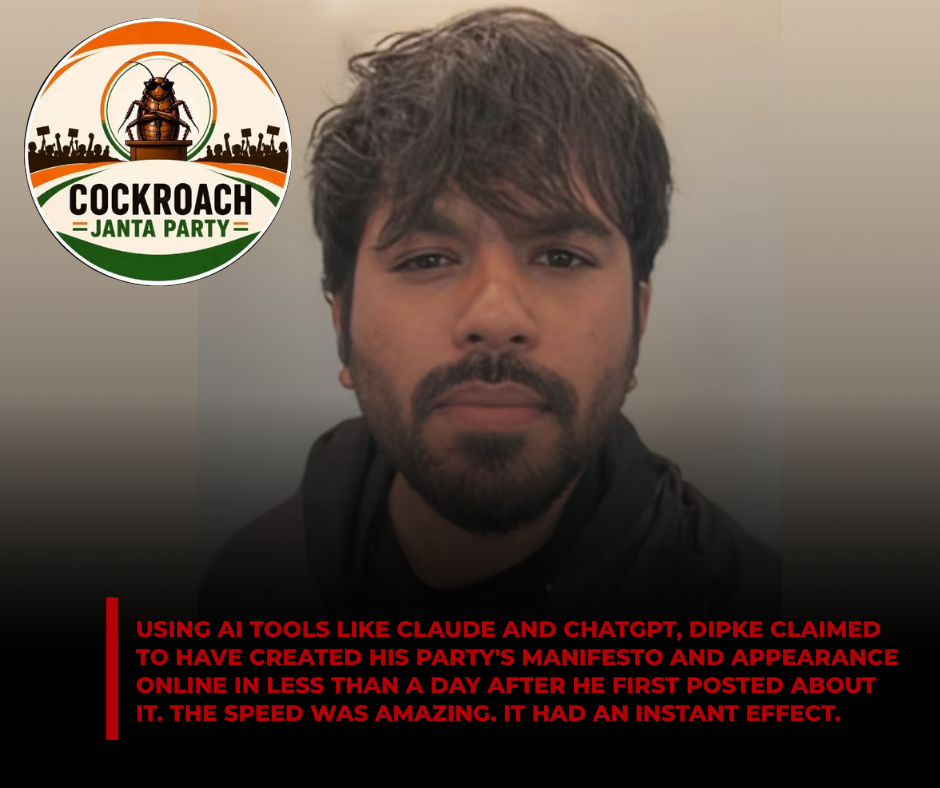
Using AI tools like Claude and ChatGPT, Dipke claimed to have created his party’s manifesto and appearance online in less than a day after he first posted about it. The speed was amazing. It had an instant effect.
The Cockroach Janata Party Goes Viral: Numbers That Stun
The growth of the Cockroach Janata Party defied all conventional metrics of online engagement. Within 48 hours, the movement claimed over 40,000 registered members, with later reports suggesting figures exceeding 70,000.
The Instagram numbers were even more staggering. Within 78 hours of its launch, the account reportedly crossed 3 million followers. It then surpassed 10 million followers in less than five days, overtaking the ruling Bharatiya Janata Party’s official handle.
India’s newest viral political satire phenomenon triggered a fierce debate online after crossing 20 million followers on Instagram and overtaking the official Instagram followings of both the Bharatiya Janata Party and the Indian National Congress.
An unofficial handle also surfaced on X and it garnered over 15,000 followers within just 24 hours of its launch. The movement had crossed 350,000 total sign-ups within days. No mainstream political party had ever grown this fast online.
What Does the CJP Actually Stand For?
The Cockroach Janata Party has a witty, satirical platform. Allegations of voter manipulation against the Modi government, a largely compliant corporate media, and the appointment of judges to government positions after their retirement are all topics on which the CJP’s manifesto takes a tough stance.
Important demands include a 20-year election ban on politicians who change parties, a 50% reservation for women in cabinet positions, and a complete ban on Chief Justices holding Rajya Sabha positions after retirement in order to preserve judicial independence.
According to the party, its goals are not to “set up another PM CARES, holiday in Davos on the taxpayer’s salary slip, or rebrand corruption as strategic spending.” It exists to loudly and repeatedly enquire as to the whereabouts of the funds. It has a satirical tone. However, the demands are significant. The point is exactly that contrast.
The satirical eligibility checklist for membership required members to stay physically lazy while their brains continued to spiral, remain unemployed by force, choice, or principle, spend at least 11 hours online every day on a regular basis, and rant professionally with insightful and truthful content.
Cockroach Janata Party Spreads to Pakistan
Inspired by the quickly expanding Cockroach Janta Party, the viral “cockroach movement” that started in India as online political satire has now spread to Pakistan, giving rise to several parody political organisations.
In Pakistan, a number of organisations have formed, such as the Cockroach Awami Party and the Cockroach Awami League. The Muttahida Cockroach Movement, a third group, also emerged quickly after.
Although many of the accounts use Pakistan’s green-and-white colour scheme to create a local political flavour, they still bear a striking resemblance to the visual identity of the Indian Cockroach Janta Party.
The Cockroach Awami Party describes itself as “a political front of the youth, by the youth, for Pakistan.” In its bio, CAP freely admits that it copied the idea from the Indian movement by stating, “Yeah copied but who cares.” The motto remains the same.
The Pakistani offshoots, on the other hand, seem much more dispersed than the Indian version, with various creators independently releasing their own iterations of the cockroach identity. Every version reflects a different national annoyance. Nonetheless, the brand is still instantly identifiable.
The Controversy: Bots, Foreign Followers, and Political Warfare
Every viral movement is scrutinised. The Cockroach Janata Party’s rapid expansion was accompanied by harsh criticism. The makeup of the CJP’s social media following became a hot topic on the internet, with many users asserting that a sizable portion of the party’s supporters are foreign-born.
According to one X user, “77% of their Instagram followers are from Pakistan, Bangladesh, and the United States.” Just 9% comes from India. Others said that “Pakistan, Bangladesh, Turkey and supporters of Congress, Aam Aadmi Party, and SDPI have all started promoting Cockroach Janata Party.”
Given the page’s exceptionally quick growth, some users claimed that a sizable portion of the followers might be bots or dormant accounts. These accusations were met with a sharp response from the founder, who dismissed them as political attacks.
The controversy reveals a deeper truth. Coordinated opposition will target any movement that challenges the status quo, and the speed of the pushback confirms the CJP’s threat level.
Editor’s Perspective
Here is my reading of what this moment actually means.
There is more to the Cockroach Janata Party than just a meme. It is a tool for diagnosis. It reveals just how detached India’s institutional elite has become from the country’s youth’s real-life experiences. When an Indian Chief Justice refers to young people without jobs as “cockroaches” in public, it reveals a lot about who is in charge and who they believe should have it.
There was no political party founded by Abhijeet Dipke. He constructed a mirror. “Look at what you are doing to these people,” he said, holding it up to the system.
The Power of One Laptop and One Grievance
The CJP’s medium is what actually poses a threat to the status quo. Television was not necessary for this movement. Print advertising, rally planning, or party funding were not required. It required two AI tools, one astute founder, and a valid complaint. The movement that resulted from this combination was greater than the online presence of either major national party.
Take a moment to consider that. With their decades of infrastructure and campaign expenditures of crores of rupees, the BJP and Congress are unable to naturally match what a 30-year-old in Boston created in 72 hours using a laptop. That provides all the information you need to understand how political power is changing.
The expansion into Pakistan is just as important. Digital satire, elite disdain, and youth unemployment are not exclusive to India. These are the realities of South Asia. Permission was not required for the Cockroach Awami Party or its affiliates to exist. When they saw the template, they immediately embraced it. In the era of Instagram, political contagion looks like this.
What Happens Next: My Prediction
There is a crucial fork in the road for the CJP. Option 1: When a meme cycle ends, it fades. The followers stray. The momentum fades. It ends up as a footnote in a book about the history of digital culture. Option two develops into a true electoral infrastructure, and I think this is the more likely course. CJP supporters are reportedly considering running in Bihar’s Bankipur Assembly by-election. It’s not a meme. It’s a ballot box.
When the movement has to make the challenging shift from outrage to governance narrative, that will be the true test. On the internet, satire triumphs. At polling places, manifestos are successful. Dipke has the tactical tools necessary to make that leap thanks to his AAP experience. Driven by social energy and improbable electoral aspirations, the AAP started out as an anti-corruption movement. We are aware of the conclusion of that tale.
How the Establishment Will Fight Back
The establishment will employ three predictable tactics in an effort to neutralise the CJP. They will first attempt to use bot accusations to undermine its fan base. Second, without giving up any genuine policy ground, they will try to appropriate its language. Third, if those two don’t work, they’ll try regulatory suppression, maybe through laws governing social media content or Election Commission investigations of unregistered “parties.”
None of those strategies will work permanently. You cannot squash a movement whose core asset is resentment at being squashed.
The youth who joined the CJP are not searching for another charismatic leader to believe in. They are searching for a respectable way to vent their anger, which the current political system ignores. They were given a language by the Cockroach Janata Party.
The next ten years of Indian youth politics will be shaped by what they do with that language. Without reservation, I declare that the most significant political satire movement is the Cockroach Janata Party. India has produced since the 2011 Anna Hazare uprising. The medium is not the same. The energy is the same. Don’t write off this as merely a viral phenomenon. It’s a valve for pressure. And for years, the pressure behind it has been increasing.
What Comes Next for the Cockroach Janata Party
Sustainability is currently the most pressing issue. Is it possible for the CJP to transform social media energy into organised political engagement? The Cockroach Janata Party is not currently a recognised political organization.
It primarily serves as a meme-based digital campaign and satirical online movement. Online, some supporters have talked about expanding it into a bigger political or social platform in the future. It’s unclear if it develops into a legitimate organization or disappears as a passing internet fad.
Sincere ambition is indicated by the interest in the Bankipur by-election. The movement’s identity is permanently altered by a credible electoral debut, even if it is only symbolic.
It becomes a political actor instead of a punchline. As mainstream parties start to imitate its style and vocabulary, the CJP must also maintain its core base. Its best quality is authenticity. It loses everything the instant it begins to sound like the system it criticises.
India needed the arrival of the Cockroach Janata Party. Whether history remembers it as a joke or a pivotal moment will depend on whether it survives its own viral moment.
It turns out that the cockroaches are observing.
FAQs
Describe the Cockroach Janata Party?
On May 16, 2026, an Indian satirical political movement went viral after a Supreme Court judge referred to young people without jobs as “cockroaches.”
Who started it?
Boston University student and former AAP digital strategist Abhijeet Dipke is thirty years old. He used AI tools to build it in a single day.
What caused it to become viral?
By transforming an elite insult into a Gen Z identity, it gained 20 million Instagram followers in a matter of days, surpassing both the Congress and the BJP.
Did it spread outside of India?
Indeed. In a matter of days, Pakistan gave rise to imitation organisations such as the Muttahida Cockroach Movement and the Cockroach Awami Party.
Will it run for office? Maybe. The Bankipur Assembly by-election in Bihar is of interest to supporters. For now, it is still not registered.











Leave a Reply