
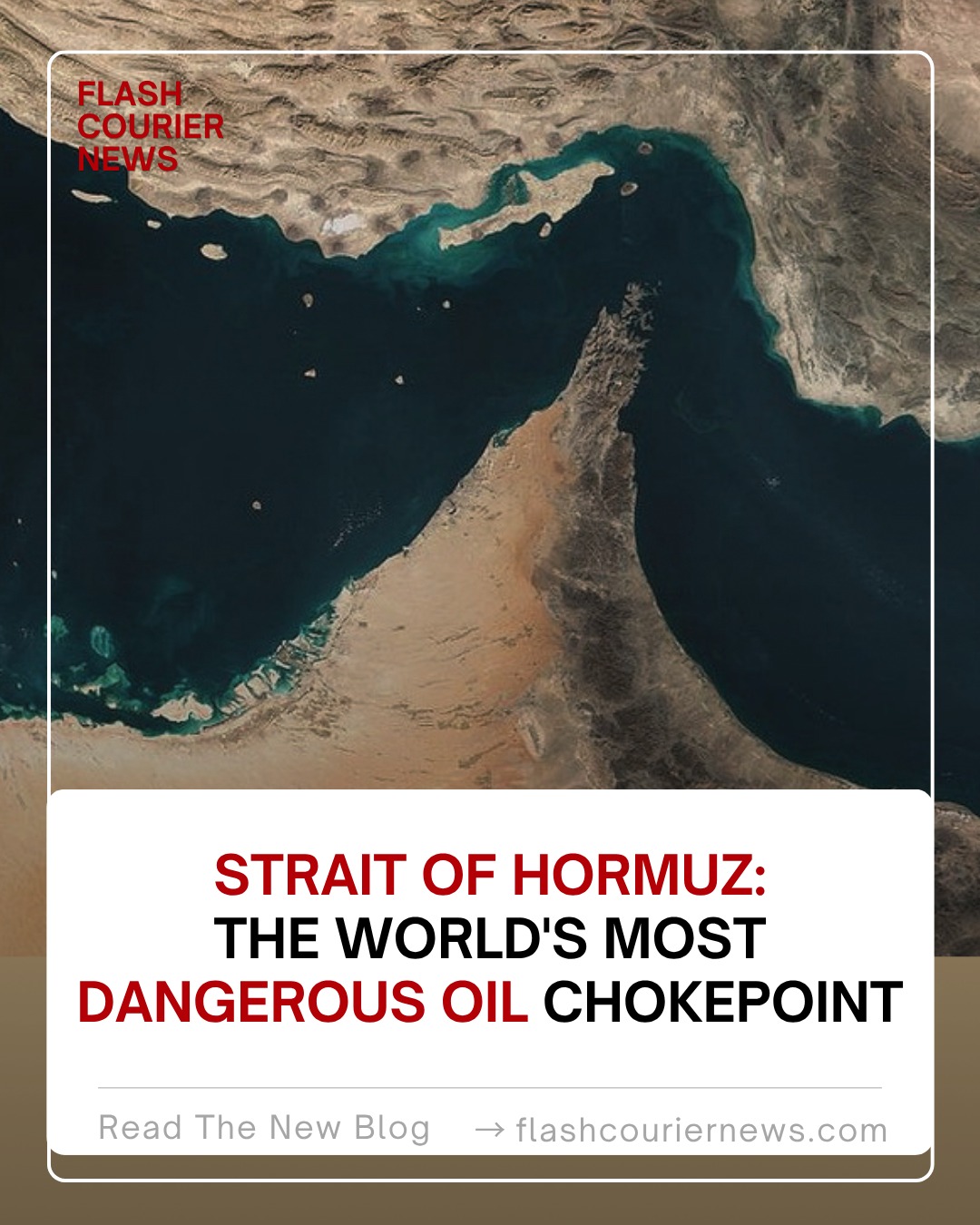
I am discussing geopolitics relevant to the Strait of Hormuz, the world’s most dangerous oil chokepoint, which is the intriguing relationship between geography (the formation of the globe) and politics (the interactions between individuals and nations).
Today, we are learning about the significance of the Strait and how its narrowness has made it a focal point of international disputes.
Where on Earth Is the Strait of Hormuz?
Let’s start by determining the location of this vital canal. Strait of Hormuz: The World’s Most Dangerous Oil Chokepoint
Look at the Arabian Peninsula.
- The Red Sea, which stretches between the peninsula and Africa and joins the Mediterranean via the Suez Canal, connects the Arabian Sea to the Mediterranean on the peninsula’s eastern side.
- The Arabian Sea empties into the Gulf of Oman, which links to the Persian Gulf, on the opposite side of the peninsula.
And in between these two abysses? The Strait of Hormuz is a very small body of water.
Three nations encircle the Strait on either side:
- Iran (in the north)
- Oman (to the southeast)
- United Arab Emirates (in the southwest)
Why Is the Strait of Hormuz So Important?
- On some of the largest ships in the world, the Strait of Hormuz: The World’s Most Dangerous Oil Chokepoint facilitates the daily transportation of LOADs of oil.
- The Strait of Hormuz is the world’s most significant oil transport chokepoint due to its extreme narrowness and the enormous amount of oil that passes through it.
How Much Oil Actually Passes Through?
Approximately 21 million barrels of oil and other petroleum liquids passed across the strait every day on average in 2018.
- Each barrel is about 159 litres
- That equals a total of over 3 billion litres per day
- That’s more than 1,300 Olympic swimming pools of liquid—every single day
This amounts to roughly 21% of the daily petroleum usage worldwide.
This one small river carries one-fifth of the world’s oil consumption.
- The Strait of Hormuz is traversed by one-third of all oil transported by ship worldwide.
- Additionally, 25% of all natural gas traded goes via
How Narrow Is the Strait of Hormuz?
At its narrowest point, the Strait of Hormuz is only roughly 39 kilometers wide.
That is about the distance between the city’s center and its periphery. or roughly a half-hour highway journey.
Ships passing through the strait are required to adhere to stringent shipping lanes due to its low width. Error is not an option.
Nevertheless, the Strait of Hormuz is deep enough to handle the biggest ships on the planet, known as Very-Large Crude Carriers (VLCCs) and Ultra-Large Crude Carriers (ULCCs), despite its short width.
The Carefully Choreographed Dance of Oil Tankers
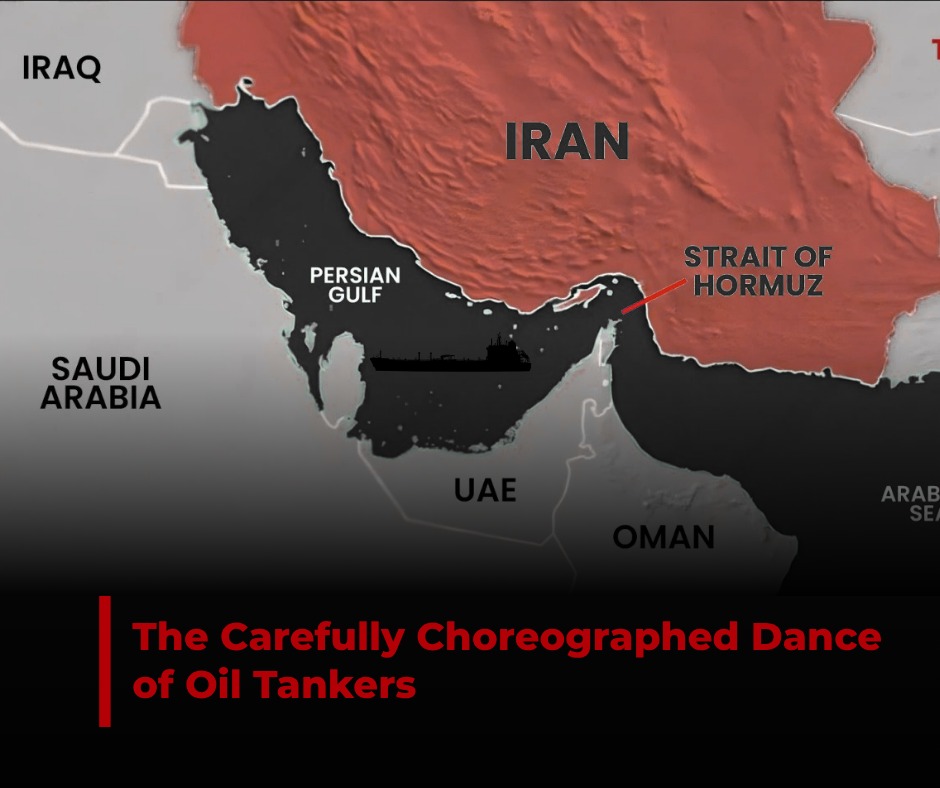
When big ships leave the Persian Gulf through the Strait of Hormuz, they have to take part in a well-planned dance.
This is how a supertanker travels:
Territorial Waters of Iran
Iran’s territorial waters are where the first shipping lane begins.
The Disputed Islands
After that, it travels via three islands that the UAE claims but are presently governed by Iran.
Territorial Waters of Oman
In order to navigate the narrowest shipping lanes in the narrowest section of the strait, the supertanker must next enter Omani territorial waters.
Oman’s Gulf
Ships can return to Iranian territorial waters via additional shipping lanes in the Gulf of Oman after passing through the Strait.
The entire path might be disrupted with just one incorrect move and one ship out of place.
Where Does All This Oil Go?
You could assume that the majority of Persian Gulf oil travels west to either Europe or America.
In actuality, no.
Approximately 76% of the crude oil that was transported over the Strait in 2018 went to Asia.
And only five nations received the majority of that:
| Country | Region |
| China | East Asia |
| India | South Asia |
| Japan | East Asia |
| Singapore | Southeast Asia |
| South Korea | East Asia |










Leave a Reply