
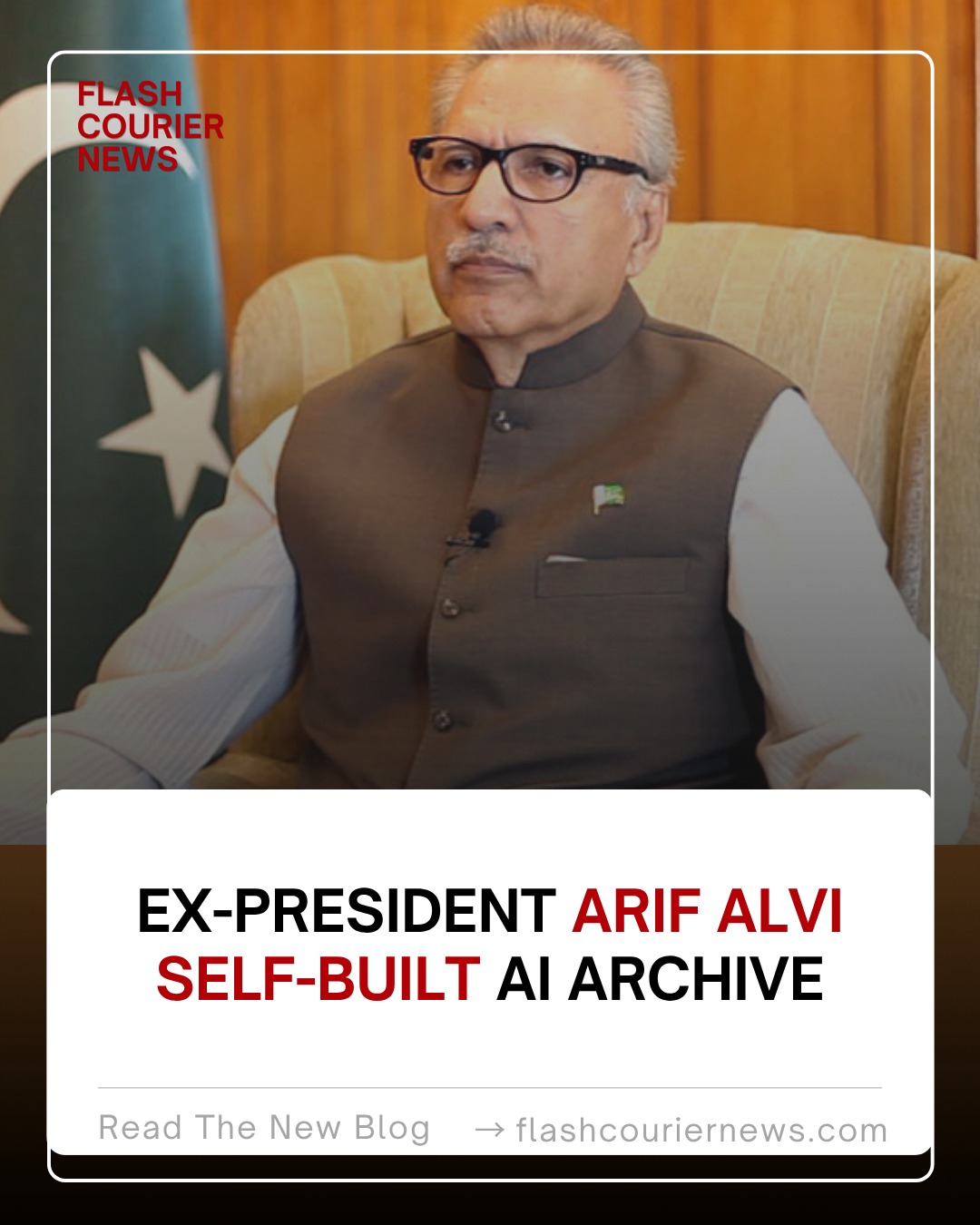
While in exile from Pakistan, former President Dr. Arif Alvi created a private, local AI repository comprising thousands of lectures and more than 50,000 tweets. He provides a potent message for young Pakistanis together with the open-source stack (Whisper, Ollama, and RAG): Immediately begin developing AI.
Dr. Arif Alvi, the former president of Pakistan, broke his online quiet using a Python script and a GitHub link rather than political speech.
Dr. Alvi made a dramatic shift toward the future while admitting the significance of his leader Imran Khan’s political jail. What was his message? “He would urge Pakistan’s youth to continue developing, particularly in artificial intelligence. particularly right now.”
What came next was a technical journal that reads like the confession of a startup founder, but the founder is a former head of state, and his “startup” is a local, private AI archive that he developed on his own, with no funding, on an upgraded laptop.
The Problem: Mixed-Language Transcription
Dr. Alvi’s journey started with a particular personal issue. He had to transcribe lengthy (more than thirty minutes) presentations that combined Urdu and English. Existing platforms were a complete failure; YouTube continued to return transcripts in Hindi and Sanskrit.
He asked his “coaches” (ChatGPT, Claude, Gemini) how to solve the problem rather than waiting for a solution. By December 2025, he had developed a local transcriber that was optimized for bilingual transcription utilizing OpenAI’s Whisper (big, medium, and tiny models).
Open Source Release: He posted the code on GitHub in an effort to be transparent. The Repository: http://github.com/DrArifAlvi/youtube-urdu-transcriber
The Magnum Opus: The Dr. Arif Alvi AI Archive
Dr. Arif Alvi Self-Built AI archive scaled his project by January 2026. He created a private AI called a local RAG (Retrieval Augmented Generation) system that is aware of everything he has ever written, spoken, or read.
The information consumed consists of:
- Thousands of books (read and summarized).
- Millions of words from archives.
- Thousands of speeches, press conferences, and talk show appearances on YouTube (since 2000).
- More than 50,000 tweets may be semantically (by meaning) searched more quickly than X’s own tools.
The Open-Source Stack (Available to Everyone)
Arif Alvi Self-Built AI Archive quickly points out that although his composition is special, any Pakistani students can use the ingredients for free.
“What I built is one-of-one. But what I built it from is available to every-one.”
His Local Stack:
- Ollama / Llama / Phi / Qwen (Local LLMs running on-device)
- Whisper (Bilingual Urdu/English transcription)
- ChromaDB (Vector memory across 70,000+ chunks)
- Sentence Transformers (Semantic search)
- Streamlit (Dashboard for search and AI research)
The Hard Truth: You Don’t Need to be a Programmer
Dr. Alvi’s recommendation for the “tens of thousands of students, researchers, lawyers, and doctors” experimenting with AI is arguably the most radical aspect of his post.
“Nowadays, most software authoring is done by machines. You don’t have to learn programming. Like a symphony conductor with an AI baton, you must have sufficient comprehension to read, direct, correct, and use tools.”
A Message of Strategic Urgency
Dr. Alvi informs readers that in 2019, he initiated Pakistan’s Presidential Initiative on Artificial Intelligence. However, this isn’t nostalgia.
“Pakistan cannot afford to lag behind—not out of nostalgia for the country’s past, but rather due to the strategic and economic need of its current state.”










Leave a Reply