

American life is changing due to a significant cultural shift. Pets are now more important to Americans than children. In a recent Harris Poll, 40% of Americans stated that they would prefer to have pets over children, while only 21% said the opposite.
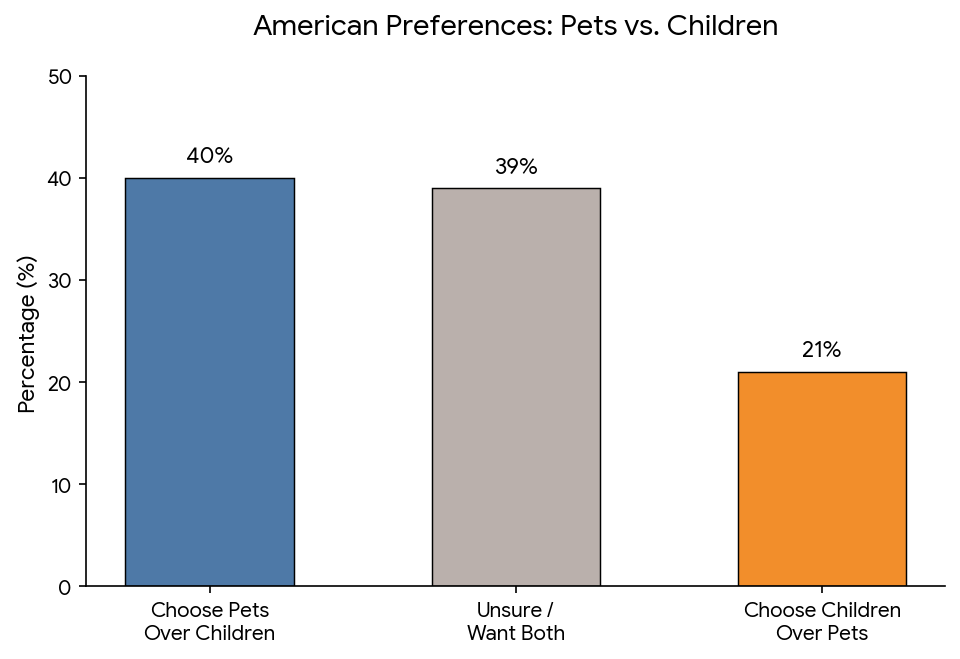
This is a movement motivated by economic uncertainty, changing values, and a reinterpretation of what family means in 2026; it is not merely a matter of personal preference.
Quick Overview
| Detail | Information |
| Americans choosing pets over kids | 40% (vs 21% choosing kids) |
| Gen Z/Millennials considering pet-only life | 55% |
| Pet owners who treat pets as family | 82% |
| Annual U.S. pet spending | $180 billion |
| Average yearly pet spending | $4,366 |
| Gen Z average yearly pet spending | $6,103 |
| Millennials average yearly pet spending | $5,150 |
| Pet owners who would give up years of life for a pet | 63% |
Why Are Americans Choosing Pets Over Kids?
Economic Uncertainty
The main motivator is money. Over half of Americans (55%) claim that their financial circumstances are getting worse. For the fifth year in a row, Americans have said that things are getting worse rather than better.
The numbers tell the story:
- Raising a child costs approximately $300,000 over 18 years.
- The cost of raising children has risen by 25%, while earnings have grown by just 3%.
- Average lifetime care for a dog: $34,550 (over 10 years).
- Average lifetime care for a cat: $32,170 (over 16 years).
Libby Rodney, chief strategy officer of The Harris Poll, explains: “If you feel like you are worried about losing your job or you don’t know where you’re going to be in the next five years, or you don’t know where that stability is coming from, adding a child into that life feels really challenging”.
Pets Provide Emotional Stability
Pets provide unconditional emotional support and stability in a time of anxiety that children cannot match.
Key findings:
- 94% of pet parents agree pets are essential for personal fulfillment.
- 84% say their dog’s love is one of the most important contributors to their happiness.
- 81% of pet parents say pets reduce stress.
“The core identity of seeing pets as family and prioritizing them as such has just become so central to the American modern family story,” Rodney adds.
Gen Z and Millennials Leading the Shift
The generational divide is striking:
| Generation | View of Pets |
| Boomers/Gen X | See pets as best friends |
| Gen Z/Millennials | See pets as children |
Key statistics:
- Millennial pet parents are 17 times more likely than boomers to delay children in favor of pets.
- 55% of Gen Z and millennials have considered building a life around pets only.
- 50% of Gen Z agree a pet is a good “trial” before having a human child (vs 28% of boomers)
The DINKWAD Phenomenon
This cultural shift is reflected in the rise of DINKWADs (Dual Income, No Kids, With A Dog). In England, dogs now outnumber children in one in three neighborhoods, and the trend is accelerating in the US as well.
How Pet Parents Are Sacrificing
Pet parents aren’t just choosing pets—they’re making significant sacrifices to afford them.
Spending Comparison
| Generation | Average Annual Pet Spending |
| Boomers | $2,454 |
| Millennials | $5,150 |
| Gen Z | $6,103 |
What Pet Parents Give Up
According to Harris Poll data, pet owners are willing to make extreme sacrifices.
- 67% would give up alcohol for a year.
- 62% would leave social media.
- 50% would give up three years of vacations.
- 48% would spend $10,000.
- 43% would leave a job promotion.
Additionally, 63% of pet owners said they would even give up years of their own lives to make their pets live longer.
Financial Sacrifices

Younger pet parents are going to great lengths.
| Sacrifice | Gen Z/Millennials |
| Cooking at home more | 61% |
| Switching to cheaper groceries | 46% |
| Cutting back on comfort purchases | 45% |
| Taking on side gigs | 37% |
| Delaying debt payments | 28% |
| Skipping medical appointments | 25% |
29% of Gen Z and millennial pet parents have gone into debt for their pets.
The “Furry First Child” Movement
A new study from Life360 found that pets are reshaping modern family dynamics. Over 120,000 new Pet Profiles are added to the family connection app each week, with 62% belonging to households without children.
Why Pets Are Becoming “Furry First Children”
For many, pets serve as a “rehearsal” for parenthood:
- 55% say a “furry first child” is a good way for couples to see if they are ready for children.
- Pets help develop patience (57%), time management (48%), playfulness (45%), emotional nurturing (43%), and financial planning skills (32%).
Pets are increasingly integrated into daily life:
- Over 75% of SIPP (Single Income Pet Parent) and DIPP (Double Income Pet Parent) daily routines are shaped by their pets.
- Nearly a third bring their pets to at least 3 public venues each week: 31% bring pets to restaurants, 16% to grocery stores, 14% to offices.
The Pet Parenting Lifestyle
Redefining Relationships
Pets have become a non-negotiable part of modern relationships:
- 78% agree that “not treating pets like family is a red flag when forming close relationships.
- 49% of single pet owners would rather skip finding a romantic partner and hang with their pet instead.
- 64% of pet parents are unlikely to date someone who doesn’t want pets.
Splurge Culture
“It’s just becoming kind of mainstream that you splurge on your pet and you kind of sacrifice elements of yourself,” Rodney explains. “You do that because it feels good to spoil your pet or your animal versus maybe keep spending on yourself.”
What this means for business: “Pets are where all brands need to be playing right now, because even when discretionary income is tight, even when they’re in debt, Gen Z and millennials are still splurging on their pets”.
The Policy Gap: What Pet Parents Want
Despite the cultural shift, policy hasn’t caught up. Pet parents want legal recognition for their “fur babies”:
- 69% would adopt their pet as a dependent if legally possible.
- 68% believe pet owners should receive tax breaks similar to child-related deductions.
- 42% want tax deductions for pet ownership.
- 37% want rent control for pet fees and deposits.
Conclusion
Bigger economic and social changes in America are reflected in the “pets over kids” controversy. For many younger Americans, having a pet has become the most sensible way to start a family due to rising expenses, shifting values, and unstable finances.
As Libby Rodney puts it: “For a generation drowning in economic uncertainty, pets have become the most rational way to build a family”.
It’s unclear if this trend is a reaction to the present circumstances or a long-term change. However, one thing is certain: pets are at the core of the redefining of the American family.
Frequently Asked Questions
What percentage of Americans choose pets over kids?
40% of Americans would choose pets over children, compared to 21% who would choose children.
Why are Gen Z and millennials choosing pets over kids?
Economic uncertainty, rising costs of raising children (25% increase in two years), and pets providing emotional stability in an anxious era.
How much do Americans spend on pets annually?
Americans spend approximately $180 billion on pets annually, with average spending of $4,366 per pet owner.
Do pet parents make sacrifices for their pets?
Yes. 63% would give up years of their own life, 50% would give up three years of vacations, and 29% have gone into debt for their pets.
Is treating pets like family considered normal?
Yes. 78% consider “not treating pets like family” a red flag in relationships.











Leave a Reply