
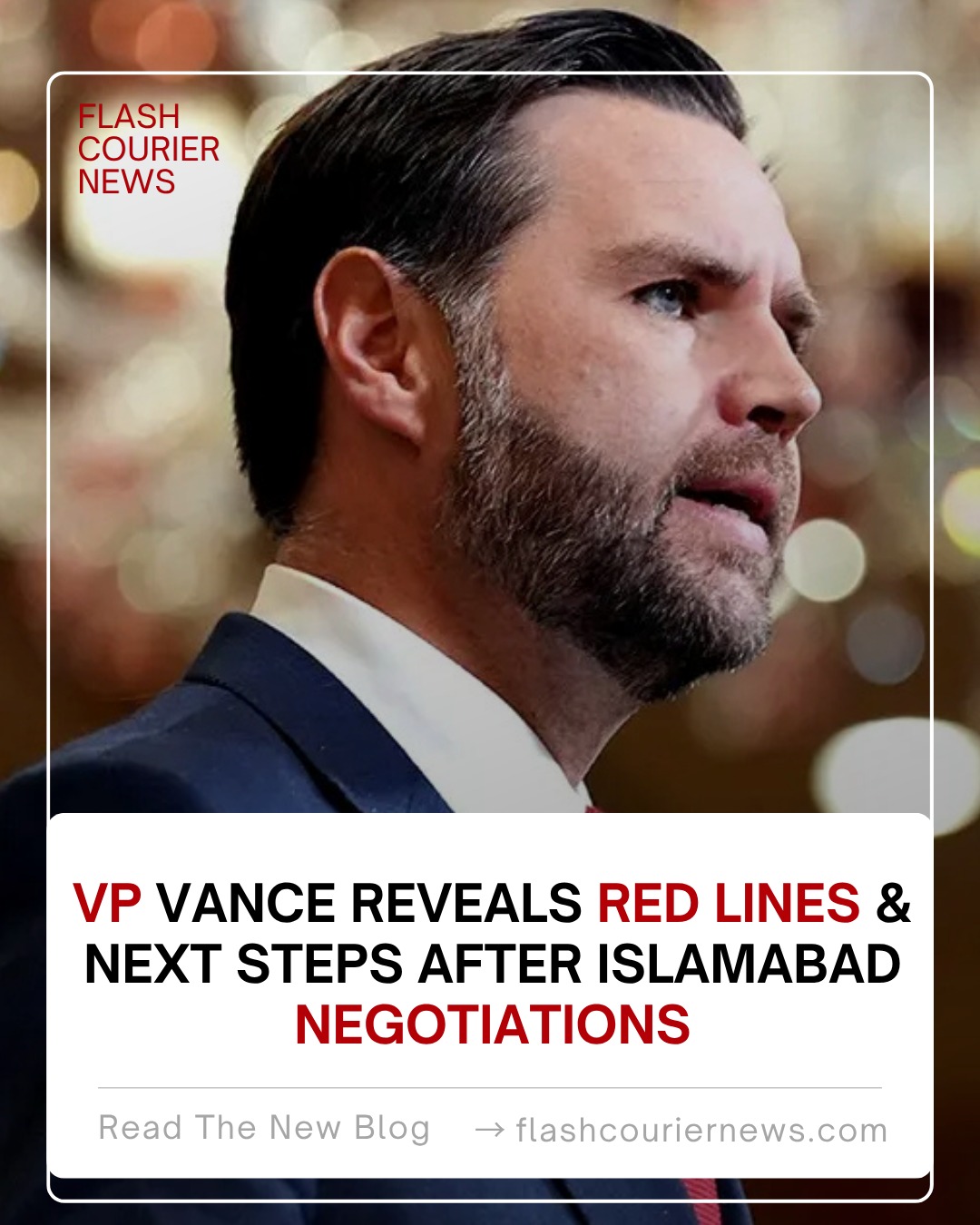
VP Vance Reveals Red Lines. VP JD Vance discusses the two non-negotiable U.S. The red VP Vance Reveals Red Lines regarding enriched uranium and verification. the reasons for the stalled talks in Islamabad, and the future of the Strait of Hormuz. embargo are all important topics.
Progress Made, But Not Enough
VP Vance Reveals Red Lines.The high-stakes nuclear talks with Iran that took place in Islamabad, Pakistan. were described in detail by Vice President JD Vance. Despite the current impasse, Vance was cautious to point out that “a lot went right,” even though the negotiations did not produce an immediate agreement.
The U.S. and Iranian leadership met at such a high level for the first time in almost fifty years. But following intense meetings, the Iranian team returned to Tehran while the American team departed for Washington. The vice President claims that Iran now has the upper hand.
The Two Absolute Red Lines (Non-Negotiables)
Vice President Vance explained that although the United States has demonstrated flexibility on a number of topics, President Trump has set two essential red lines that cannot be compromised, all of which stem from the fundamental tenet that “Iran can never have a nuclear weapon.”
- Removal of Enriched Uranium (Operation Midnight Hammer)
The United States is requesting that Iran physically remove its enriched uranium. Vance mentioned “Operation Midnight Hammer,” pointing out that a large portion of this information is presently underground.In order to give the United States sovereignty over that stuff, we would prefer to remove it entirely from the nation. VP JD Vance The intention is to completely eliminate the fuel source so that future presidents won’t have to worry about Iran’s nuclear program.
2. Verification & Cessation of Enrichment
- Iran’s declaration that they won’t seek a weapon is one thing; proving it is quite another. The United States is calling for a definitive system to guarantee that Iran cannot enrich uranium.
The Iranian team “moved in our direction” on these issues, according to Vance, but not far enough to meet the administration’s demands.
3. The “Moving the Goalpost” Moment: The Strait of Hormuz
One of the critical friction points during the Islamabad talks involved the Strait of Hormuz.
Vance claims that the United States offered a ceasefire (ending bombing campaigns) when it entered the talks. The United States anticipated that Iran would completely reopen the Strait of Hormuz to unrestricted marine traffic in return.
But according to Vance, the Iranians tried to “move the goalpost” during the negotiations. That is unacceptable, as we made very clear. VP JD Vance
Although trade across the strait has significantly increased for the United States, the full reopening that the country has desired has not yet occurred.
Economic Leverage: The Naval Blockade
Vance described the current economic pressure strategies being used in response to a question concerning the next steps. The U.S. Navy is currently stopping ships in the Strait of Hormuz that are known to be traveling to or from Iranian ports, not simply those flying the Iranian flag.
According to Vance, this is a direct reaction to what he refers to as Iranian “economic terrorism.”We will adhere to a straightforward concept if the Iranians attempt economic terrorism: “No Iranian ships are getting out either.” VP JD Vance
Since Iran has a history of intimidating international commerce with the threat of closing the strait, the administration feels that this blockade applies substantial economic leverage.
What Happens Next? The Ball is in Tehran’s Court
Vance said that it is best to ask the Iranians whether there will be more discussions (perhaps back in Pakistan).
The American squad has departed Islamabad. According to Vance, the Iranian negotiators on the ground might not have had the power to finalize the agreement and had to go back to the Supreme Leader for permission.
The American Offer: Vance restated President Trump’s willingness to accept a “grand deal.” The United States would treat Iran like a normal nation and allow its economy to flourish if Iran abandoned its nuclear aspirations and stopped aiding terrorism
“We have the military edge. We have a lot of cards, and we are under additional economic pressure.”









Leave a Reply