
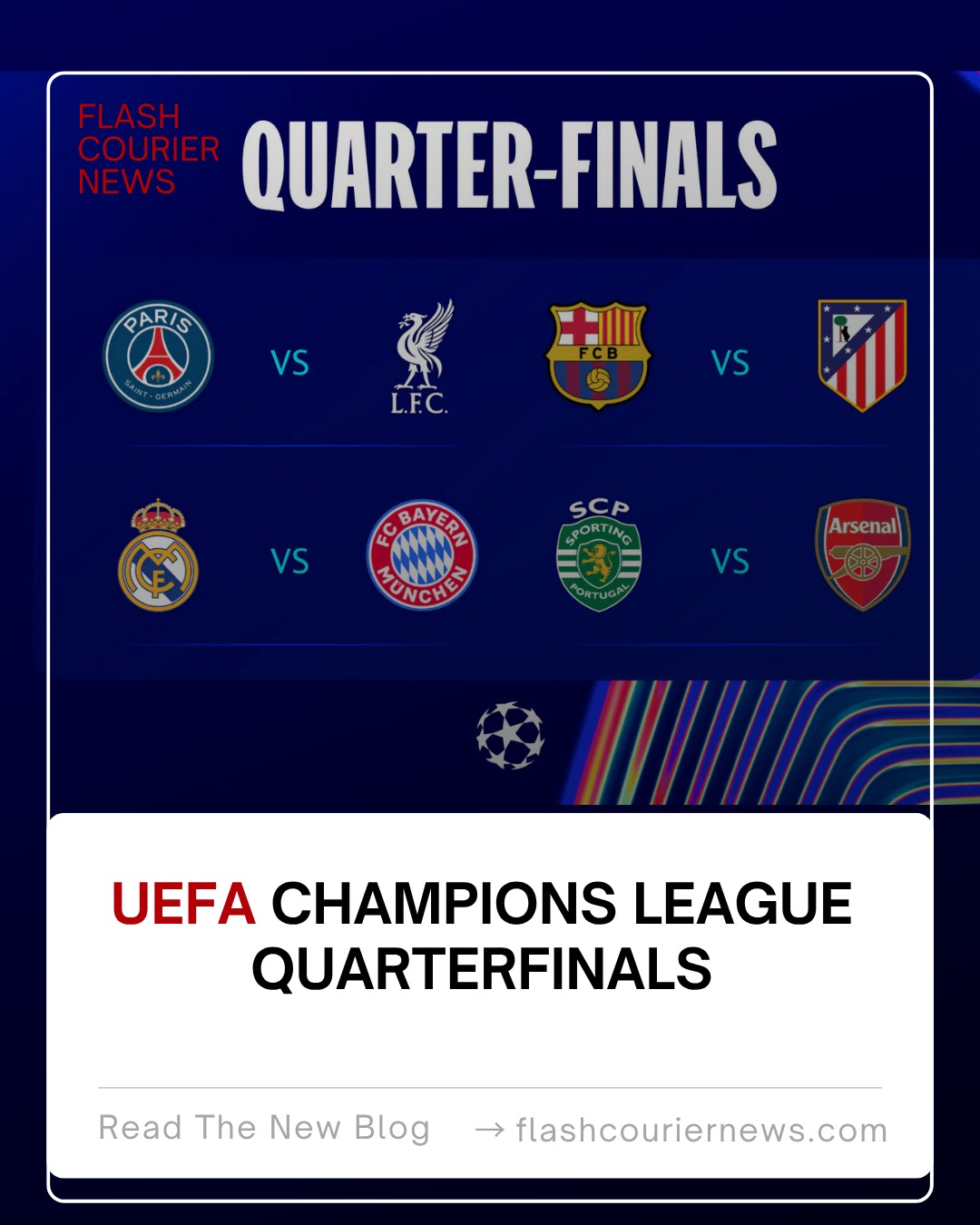
UEFA Champions League quarterfinals have provided a tactical display. Which serves as an unmistakable barometer for the current condition of European football. first-leg matches came to an end on April 7-8, 2026.The scene had changed from the hectic, high-scoring changes of prior years to a more organized, analytical approach to the game. Compact defensive setups are clearly making a comeback, inverted full-backs are becoming crucial facilitators, and seasoned superstars.who are still fiercely competing with the younger generation continue to have an impact.
In UEFA Champions League quarterfinals the European giants are on the verge of collapse as a result of the outcomes. others have shown how to undermine even the most powerful tactical systems.Below, we examine the outcomes and the specific strategic tendencies that shaped them.
PSG vs. Liverpool (2-0): High-Intensity Football’s Collapse
In the UEFA Champions League quarterfinals “Arne Slot’s developing Liverpool F.C. faced Luis Enrique’s possession-obsessed Paris Saint‑Germain F.C. in what many described as a war of footballing ideals.” The 2-0 victory for PSG revealed a glaring structural flaw in Liverpool’s defensive setup rather than individual skill.
The Result
Bradley Barcola’s strikes and Vitinha’s late finish gave PSG the lead from the first whistle.first time in more than ten years, Liverpool failed to score a single goal despite PSG’s strength and balance.
Tactical Shift: The Overburdened Midfield Pivot
By benching Mohammad Salah, Arne Slot attempted to dominate the midfield and provide a strong defence using a 5-3-2 configuration. He also attempted to close the caps to PSG players, but he was unsuccessful.
Luis Enrique, the manager of PSG, countered Arne’s slot plan by telling his wingers, Dembele and Kvaratskhelia, to remain pinned on touchlines. As a result, the play stretched Liverpool’s formation and forced their wingbacks to stay wide and deep, creating space in the middle. Players like Vitinha and Warren Zaïre-Emery took advantage of these openings by moving freely between the lines. served as “free eights.” Against Liverpool’s three-man midfield, PSG successfully formed a four-man diamond in the middle. Liverpool’s midfield completely broke down in its pressing triggers by the 30th minute as a result of their physical and mental exhaustion from chasing shadows.
Real Madrid vs. Bayern Munich (1-2): German discipline meets Bernabéu’s “aura”
Real Madrid visited the Santiago Bernabéu with a lot of momentum and were the favourites thanks to a great domestic campaign. However, Vincent Kompany’s Bayern Munich made things tough by putting on a controlled and disciplined performance that completely destroyed Madrid’s rhythm.
The Result
The Bavarians won 2-1, although Madrid’s Kylian Mbappé scored with a spectacular solo run that ended in a goal, and Bayern’s Jamal Musiala and Harry Kane’s penalty gave them a one-goal advantage.
Tactical Shift : The Neuer Factor and “Rest-Defense”
The defining shift in this match was Kompany’s refusal to engage in a track meet.Bayern used a strict 3-2-2-3 buildup structure because he was aware that Madrid relies on “chaos moments”—those ten-minute intervals in which they score three goals out of the blue.
Manuel Neuer’s role was the most intriguing subplot. Neuer was a 40-year-old literal “sweeper-playmaker.” Neuer did more than just clear the ball when Madrid tried their trademark high press; he also served as the third center back, enabling Bayern to avoid the first line of pressure by making precise vertical passes into Musiala. Additionally, Bayern’s “rest-defense”—the way they positioned themselves while in possession—was flawless. Specifically assigned to shadow Mbappé and Vinícius Júnior, they kept four players behind the ball at all times.
Bayern made Madrid play a slow, methodical game by neutralising the counterattack, which has historically irritated the Merengues.
Barcelona vs. Atlético Madrid (0–2): “Cholismo” Is Back
Diego Simeone’s “Eternal Atleti” and Hansi Flick’s “Vertical Barça” faced off in the all-Spanish quarterfinal. Despite having the greatest offensive record in the league going into the game, Barça departed the Estadiệic Lluís Companys without a goal and with a huge mountain to climb.
The Result
The outcome was a disciplined 2-0 victory for Atlético. A Barcelona team that played with ten men for seventy minutes was punished by goals from Julián Álvarez and a header from José María Giménez.
Tactical Shift:
With a boldly high defensive line that frequently forces the game into the opponent’s half, Hansi Flick’s High-Line Trap has transformed Barcelona. But Simeone set up this trap. When Barça neared the final third, Atlético deliberately gave up possession (ending with just 32%) and fell into a 6-2-2 defensive posture.
Pau Cubarsí’s red card turned the game around, but the tactical change happened right away. Simeone moved his wing-backs even farther to entice Barça forward instead of attempting to control the game with the extra man. Atleti unleashed Julián Álvarez into the open space after Barça committed their full-backs to the attack. It was a traditional “rope-a-dope” show.
Lamine Yamal was rendered ineffective by the transition from a 5-man defence to a 6-man line during prolonged pressure; each time he touched the ball, he was doubled and tripled-teamed.
Sporting CP vs. Arsenal (0–1): A Lisbon Chess Match
Rúben Amorim’s “dark horse” of the tournament hosted Mikel Arteta’s Arsenal in a game that was predicted to be high-scoring. Rather, it was the round’s most tactically rigid game.
.
The Result
Kai Havertz’s goal in the ninetieth minute gave Arsenal a slim 1-0 victory.
Tactical Shift: The Man-Marking System versus the Box Midfield
Amorim used a very aggressive man-marking strategy, which is uncommon at this Champions League level. Every Arsenal player was shadowed throughout the pitch for eighty minutes, which kept the Gunners from developing their typical rhythm.
The essential tactical change came from Arteta’s reaction in the second half. He created a “box” in the midfield. He pushed Declan Rice into a left-sided attacking position and moving Martin Ødegaard deeper. Center backs of Sporting were forced to decide whether to let Arsenal set the pace or move out of the defensive line to mark the additional man. In the last ten minutes, Sporting’s enthusiasm waned and the “man-marking” turned into “zonal chasing.” Havertz was able to locate the pocket of space needed to win the match. Arsenal’s better physical conditioning and the change to a more fluid, front three in the closing moments.











Leave a Reply