
As violence continually knocks on the doors of power, the United States faces an unprecedented domestic security issue. A lethal threat was recently handled by law enforcement just outside the executive house. The nation’s capital’s security situation is steadily declining, as seen by this horrifying physical intrusion.
A well-known U.S. Secret Service checkpoint outside the White House compound was approached by a highly armed shooter. The suspect opened fire on the monitored security booth as soon as he took a firearm out of his luggage. Officers from the Uniformed Division responded with perfect accuracy and quickly retaliated to eliminate the threat. The injured shooter was taken by emergency services to a nearby hospital, where medical professionals eventually declared him dead.
The entire executive compound was immediately placed under lockdown as a result of this spectacular altercation. Journalists were swiftly escorted off the North Lawn and into secure holding rooms by security agents. Despite being inside the executive home when the gunshots occurred, President Donald Trump was unharmed. This chaotic scenario is the most recent in a horrifying string of attacks that have recently targeted federal properties.
The White House Security Crisis’s Anatomy
The specifics of the recent gunfight highlight serious psychological factors and systemic weaknesses that underlie contemporary domestic threats. The deceased gunman was identified by law authorities as 21-year-old male Nasire Best. Before the incident, Best had lived in the Washington, D.C. region for around eighteen months. Investigators discovered that the guy fired several shots straight at federal police using a regular pistol.
| RECENT EXTREME SECURITY BREACHES (2026) | ||
| DATE | INCIDENT LOCATION | TARGET / OUTCOME |
| April 25, 2026 | Washington Hilton | WHCA Dinner / Suspect Armed |
| May 4, 2026 | Washington Monument | Patrol Attacked / 1 Hurt |
| May 23, 2026 | White House Gate | Checkpoint / Suspect Killed |
| SOURCE: U.S Secret Service Preliminary Investigative Reports | ||
This particular person had previously interacted with federal law enforcement and had a documented history of mental illness. Best was previously detained by Secret Service agents in July 2025 following an attempt to enter the White House. After that, authorities obtained a formal federal stay-away order and committed him to a mental health facility. Despite these serious warning signs, the system was unable to trace his procurement of a lethal weapon.
Fifteen to thirty rounds were fired during the fierce gunfight outside the Eisenhower Executive Office Building. During the violent gunfight between Best and the cops, a nearby bystander was shot. While numerous responding cops had rapid medical examinations, medical responders put the bystander in critical condition. The event demonstrates that both citizens and leaders are now at risk from a persistent White House security dilemma.
A Timeline of Escalating Capital Violence
The fatal shootout between Pennsylvania Avenue and 17th Street is not an isolated criminal incident. Over the course of several weeks, numerous armed individuals have targeted prominent political locations in Washington, creating an ongoing siege. The annual White House Correspondents’ Association Dinner was rocked by a chaotic assassination attempt just one month before. Cole Tomas Allen, a shooter, stormed a security magnetometer checkpoint while carrying knives and a shotgun.
After successfully firing his pistol, Allen hit a Secret Service agent squarely in the ballistic vest. Before the assailant could reach the main banquet hall, which was crowded with officials, the responding tactical forces defeated him. Later, investigators found a comprehensive political manifesto from Allen that revealed specific strategies to remove senior administration officials. The historic institutional deterrent barrier has entirely collapsed, as demonstrated by that disastrous episode.
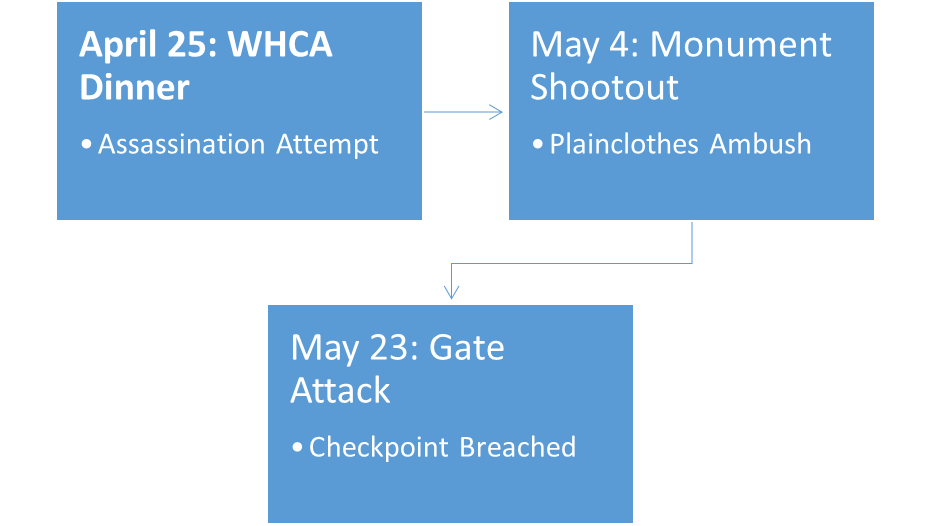
Another armed altercation broke out close to the iconic Washington Monument just nine days after the hotel attack. An armed individual was seen by plainclothes agents moving suspiciously around the popular tourist area. During a tense foot pursuit, the man grabbed his gun and opened fire on uniformed officers. A small bystander was injured in the secondary confrontation, which also necessitated another emergency lockdown of the executive house.
Why a White House Security Crisis Is Maintained by Political Violence
To explain this extraordinary spike in violence, sociopolitical observers point to a poisonous concoction of systemic flaws. Extreme partisan speech becomes operational physical directions in contemporary digital echo chambers, where radicalization flourishes. Severe isolation causes people to adopt violent beliefs as a perverted way to settle personal disputes. Unstable actors are persuaded that violence is a valid form of protest by the ongoing demonization of public institutions.
- Digital echo chambers: People who are extremely unstable can receive specific tactical inspiration from online radicalization pipelines.
- Mental Health Failures: Following initial releases, state psychiatric surveillance systems frequently fail to keep track of hazardous individuals.
- Weapon Accessibility: Psychiatric patients and convicted individuals can easily get over local limitations to purchase firearms on the underground market.
- Institutional Devaluation: Persistent anti-government propaganda weakens the innate psychological defenses against assaulting federal employees.
The persistent White House security crisis is exacerbated by the combination of untreated mental health issues and ready access to firearms. Nasire Best clearly illustrated how fierce anti-institutional attitude often coexists with serious psychiatric illusion. High-risk persons are frequently able to evade important regulatory gaps due to fragmented community health networks. The absence of aggressive federal oversight ensures that unstable individuals continue to pose extremely dangerous risks to national security.
Editor’s View: The Siege of the Capital
A structural emergency that goes beyond routine law enforcement operations is indicated by the series of armed assaults in Washington. Symbolic landmarks resemble military forward sites in the active state of siege that characterizes the American capital. We must acknowledge that a fundamental redesign of the U.S. Secret Service’s defensive approach is necessary. Frontline cops are exposed to unsustainable tactical vulnerabilities when they solely rely on outer magnetometers and perimeter booths.
| CRITICAL SECURITY WEAKNESSES | |
| PREVIOUS PARADIGM | COMPROMISED REALITY |
| Perimeter booths deter attacks. | Unstable actors view checkpoints as soft target opportunities. |
| Psychiatric release reduce risk. | Discharged patients lack active tracking and weapon monitoring. |
After these harrowing near-miss incidents, the Secret Service constantly commends its own quick response times. But eliminating an assassin after he has fired thirty shots is not a preventative victory but rather a reactionary defeat. The current administration operates in a perilous political environment where physical assassination plots are directly caused by extreme divisiveness. Predictive, intelligence-driven crowd interdiction must replace static defensive positions in security systems.
I believe that as the country gets closer to future election cycles, these blatant attacks will get more intense. A constant supply of radicalized players who target federal infrastructure is ensured by the disintegration of society. Tragedies will increase if federal threat assessments are not integrated with local mental health databases by intelligence agencies. When its own presidential palace is constantly under missile attack, the United States cannot continue to be a dominant force in the world.
Redesigning Frameworks for Perimeter Defense
The infrastructure for urban security surrounding federal areas needs to be upgraded immediately in order to physically preserve democratic leadership. Perimeter checkpoints need to develop into multi-layered, deep zones with cutting-edge non-lethal technology. Personnel at static security booths are totally vulnerable to unexpected ambushes that start from public sidewalks. Agents would be able to find hidden weapons over long distances if disguised biometric screening arrays were introduced.
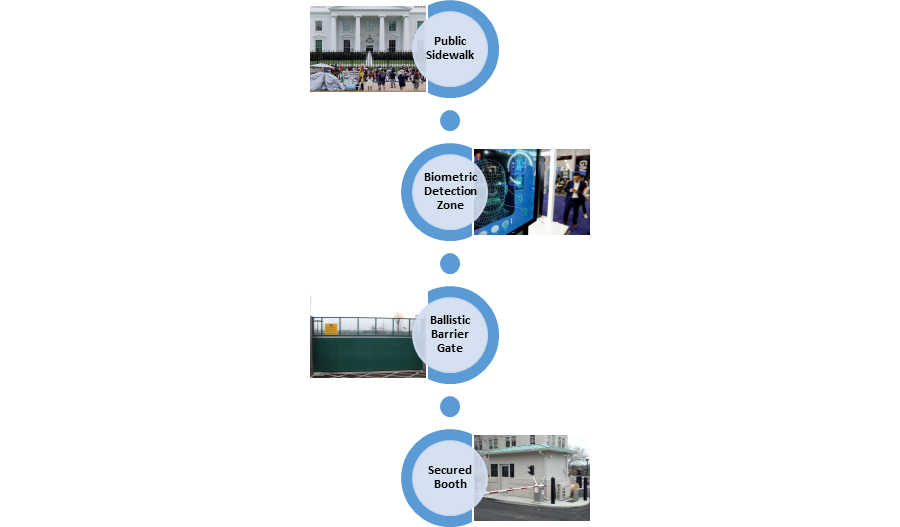
Additionally, all pedestrian junction entry points must have automatic ballistic-rated barriers mandated by the federal government. Pennsylvania Avenue’s urban architecture designs must strike a compromise between complete tactical survivability and public accessibility. When reinforced defensive chicanes are used, approaching pedestrians are compelled to travel in predictable, plainly observable lanes. Frontline guards would have vital seconds to identify and neutralize approaching attackers thanks to these physical changes.
Using Policy to Reduce the White House Security Crisis
Bold legislative action linking federal law enforcement and mental healthcare is necessary to resolve an ongoing White House security threat. A unified national database that tracks those with violent anti-government obsessions must be approved by Congress. Stay-away orders must be expanded by federal courts to include mandatory digital monitoring for hazards that have been confirmed. There are terrible national security blind spots when local police forces with inadequate funding are left to handle surveillance duties.
- Adopt Federal Tracking Mandates: Create a dynamic, multi-agency registry for people who are ineligible due to insanity.
- Use Threat Intelligence Matrices: Instantaneously link federal firearm purchase databases with local psychiatric discharge data.
- Harden Frontline Infrastructure: Install robust, multi-hit ballistic armor plating in place of all glass checkpoint booths.
- Extend Exclusionary Perimeters: Increase the distance between pedestrian restriction zones and the main walls of executive mansions.
In the end, physical armor is merely a short-term defense against a severely damaged national mentality. America needs to address the underlying socio-political deterioration that causes young people to turn their hopelessness into a weapon. The perimeter gates will continue to be bloody battlegrounds unless federal policy tackles the underlying roots of extremism. Closing these ideological divides before the next shooter gets close to the gate is essential to the republic’s protection.











Leave a Reply