
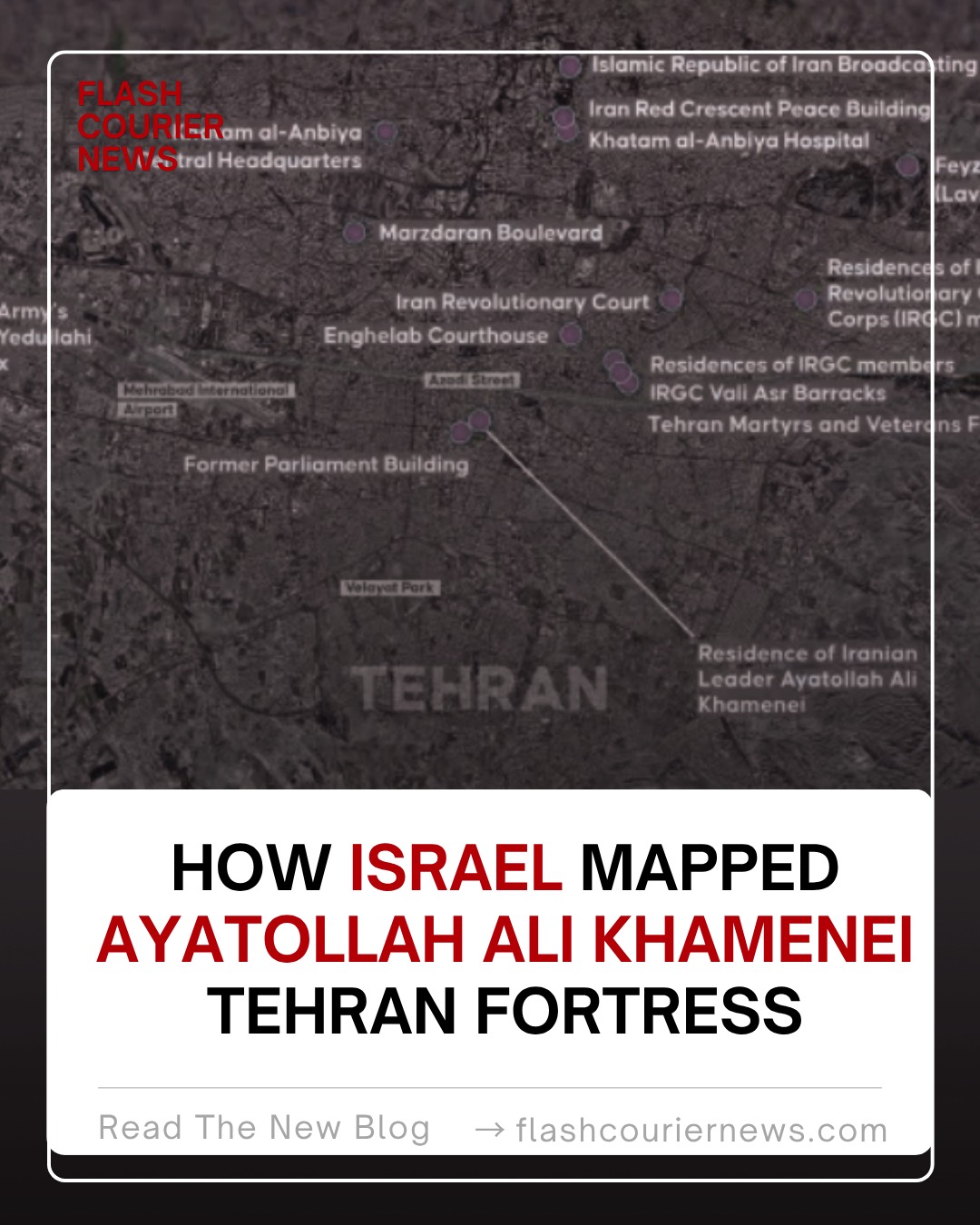
Inside Khamenei’s Secret Bunker: The 30-Acre Fortress That Defies Israel
Even the most advanced intelligence services in the world have had difficulty breaking into the well secured facility located on Pasteur Street deep within Tehran. How Israel Mapped Ayatollah Ali Khamenei Tehran Fortress.
Ayatollah Ali Khamenei, the supreme leader of Iran, resides, works, and governs here.
Understanding this facility was the top focus for years for Israeli intelligence, especially Unit 8200, Unit 9900, and Mossad’s human intelligence officers.
Where Is Khamenei’s Compound?
The Pasteur Street compound, also known as the Motahari Complex, houses Ali Khamenei’s main residence and office in a heavily protected enclave.
It’s more than just a house. This 30-acre stronghold is roughly 620 meters wide by 770 meters long.
Additionally, it is located in the center of Tehran.
What’s Inside the Pasteur Street Compound?
Let me take you on a tour of what’s truly contained within those thirty acres so you can appreciate the size of this facility.
Khamenei’s Inner Sanctum: Bayt Rahbari
Khamenei’s personal residence and office, Bayt Rahbari (House of Leadership), is located in the middle of the campus.
He resides here. Here’s where he gives orders.
Imam Khamenei Husseiniyah
Khamenei greets the public in a religious location within the property on significant occasions.
Iranian President’s Office
Indeed, this same compound houses the office of the Iranian president.
Supreme National Security Council
This location is home to one of Iran’s most influential decision-making bodies.
Mujtaba Khamenei’s Office
The compound also houses the office of Khamenei’s son, Mujtaba Khamenei, who is widely seen as a possible future successor.
The Three Layers of Security
Three separate layers are used to safeguard the entire complex.
Allow me to describe each one.
Layer 1: The Outer Perimeter (500-meter radius)
Within 500 meters of Khamenei’s inner sanctum, the uppermost layer is operational.
The Guard of Vali-e-Amr, a group of special soldiers who directly answer to Khamenei, are responsible for protecting this stratum. Not to the armed forces. Not to the head of state. Just to him.
Layer 2: The Middle Perimeter (350-meter radius)
The second layer protects individual structures within the compound and is operational within a 350-meter radius.
Iran’s most competent and reliable security forces are part of this layer:
- The ideological security force is Ansar al-Mahdi.
- Quick Reaction Unit
- Unit Nabi Akram
- Security troops of Al-Zahra
Layer 3: The Inner Perimeter (The Compound Itself)
The compound’s perimeter and individual buildings are protected by the first layer using:
- 360-degree rotating cameras
- Frequency detection devices (to catch spy transmissions)
- Mobile phone jammers (no signals in or out)
- Drone traps (to stop aerial surveillance)
- Rocket interception systems
- Advanced SAR (Synthetic Aperture Radar) security systems
How Israeli Intelligence Approached This
For a number of years, the Pasteur Street facility and Lavijan neighborhood were a top focus for Israeli intelligence, particularly Unit 8200 (signals intelligence), Unit 9900 (visual intelligence), and Mossad’s human intelligence operations. This is what they had to go past:
The Challenge: Impossible Infiltration
One of the safest places on earth is this compound.
It was practically hard to gain a human asset into Khamenei’s tight circle. The screening procedure is stringent. Security is multi-layered. The inner circle has complete loyalty.









Leave a Reply